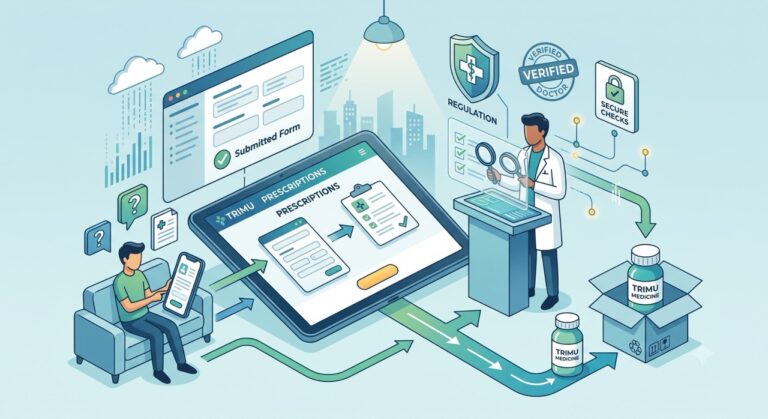



Is buying medication online safe? (And how to spot a dodgy pharmacy)
Buying medicine online has gone mainstream — it’s convenient, private, and, done properly, completely legitimate. The catch is that a parallel world of illegal sellers has grown up alongside the real thing. The good news: once you know what to look for, telling a regulated pharmacy from a dodgy one takes about two minutes. Here’s how.
The 30-second version
- Yes, buying medicine online is safe — if you use a properly regulated pharmacy.
- In Great Britain that means GPhC-registered, and (in England) a CQC-registered prescribing service.
- The simplest check: find the pharmacy’s GPhC registration number and look it up on the GPhC register.
- The biggest red flag: a site that sells prescription medicine with no consultation and no prescription. That’s illegal.
- Fake meds are a real, growing problem — the MHRA seized around £45 million of illegal medicines in 2025 alone.
So — is it actually safe?
Short answer: yes, with one condition. A regulated online pharmacy is held to the same standards as your local high-street chemist — the same regulators, the same quality-controlled supply chain, the same professional accountability. The convenience is genuine, not a trade-off against safety.
The risk lives entirely in the unregulated market. Between 2021 and 2025 the MHRA seized roughly 19.5 million doses of illegally traded erectile dysfunction pills alone, and tests on seized fakes have turned up everything from no active ingredient at all to the wrong dose, undeclared drugs and toxic substances — in some samples, things like antifreeze and rat poison. Unlicensed products are never assessed for safety, quality or whether they even work. So the goal here isn’t to scare you off buying online — it’s to make sure you land on a real pharmacy, not a criminal one.
Skip the guesswork
Trimu is CQC-registered, dispenses through a GPhC-registered pharmacy, and only prescribes after a proper consultation. Every box you’d want ticked, ticked — with free, discreet delivery and a team you can actually reach.
How to check a UK online pharmacy in two minutes
- Find the GPhC registration number on the website, then look it up on the GPhC register. Check the pharmacy name, trading name and address match. This is the single most reliable check you can do.
- Don’t rely on a logo. The old “internet pharmacy” logo scheme was discontinued at the end of 2025, so a logo (or the lack of one) no longer proves anything. The register is what counts now.
- Check the prescribing service is CQC-registered if it’s based in England. You can verify any provider on the Care Quality Commission website.
- Make sure there’s a real consultation. A legitimate pharmacy asks about your health before prescribing — and is willing to say no. If you can drop prescription medicine straight into a basket, walk away.
- Look for the boring details: a UK address, a named superintendent pharmacist, and a way to reach a real person.
- In Northern Ireland, pharmacies register with the PSNI instead, and online sellers there still display the MHRA Distance Selling Logo.
Green flags: signs you’re in safe hands
- A GPhC registration number you can actually find and verify on the register.
- It requires a consultation before prescribing, and can decline.
- A UK address, a named pharmacist, and contactable support.
- Secure checkout, clear pricing, and honest information about side effects.
- It doesn’t pressure you or promise miracles.
Red flags: walk away
- It sells prescription-only medicine with no prescription and no questions asked. (This is illegal in the UK.)
- No GPhC registration number — or the details don’t match the register.
- Prices that look too good to be true.
- Payment only by cryptocurrency or bank transfer, or no secure checkout.
- Spelling and grammar errors, pop-up ads, or claims like “100% safe” and “no side effects”.
- You found it through spam email, a social media ad, or a message from a stranger.
- No UK address and no way to speak to a real person.
Think you’ve already bought from a dodgy site?
- Stop taking it, and keep the packaging.
- If you feel unwell, speak to a pharmacist or GP, or call NHS 111. In an emergency, call 999.
- Report the seller and any suspected fake to the MHRA through its #FakeMeds campaign, and report side effects via the Yellow Card scheme.
- Keep an eye on your bank and card — dodgy sites are a common source of fraud.
Everything in one place: your Trimu portal
- Speak to a clinician — message your prescriber with questions, no awkward waiting room.
- Manage your prescription — order, track and adjust your treatment when it suits you.
- Report side effects — flag anything that doesn’t feel right and our team will review it quickly.
Quick questions
Is it legal to buy prescription medicine online in the UK?
Yes — from a registered pharmacy, after a valid prescription. What’s illegal is a website supplying prescription-only medicine without one. A legitimate online pharmacy arranges the prescription through a consultation with a registered prescriber.
Do I always need a prescription?
For prescription-only medicines, yes. Some products are available over the counter, but if a site offers prescription medicine with no consultation at all, that’s a serious red flag rather than a convenience.
Is a cheap price always a bad sign?
Not always — registered pharmacies compete on price too. But prescription medicine that’s dramatically cheaper than everywhere else is a classic warning sign. Verify the pharmacy on the GPhC register before you trust the price.
How do I actually check the pharmacy is real?
Find its GPhC registration number on the site and search the GPhC register at pharmacyregulation.org/registers. Confirm the name and address match. In England, you can also check the prescribing service on the CQC register.
Are the medicines the same as from a high-street pharmacy?
From a registered pharmacy, yes — they come through the same regulated, quality-controlled supply chain. The difference with illegal sellers is that you have no idea what’s actually in the box.
What should I do if I think I’ve taken a fake?
Stop taking it, keep the packaging, and get advice from a pharmacist, GP or NHS 111 if you feel unwell (999 in an emergency). Report the seller and any suspected fake to the MHRA via its #FakeMeds campaign, and watch your bank for fraud.
Medical disclaimer. This article is general information about buying medicines online safely — it isn’t personalised medical advice. Always use a registered pharmacy, and speak to a clinician about what’s right for you. Trimu is a trading name of AO Health Ltd, registered with the Care Quality Commission (CQC) and dispensing through a GPhC-registered pharmacy. If you’re worried about your health, speak to a clinician; in an emergency, call 999. Information correct at the time of publication. Clinically reviewed by Babar Arshad, Superintendent Pharmacist (GPhC reg. 2074066).