

Male Pattern Baldness & DHT Explained
If your hairline’s been quietly retreating, you’ve probably wondered why me? The short answer is a hormone called DHT, a bit of genetic bad luck, and an enzyme most people have never heard of. Here’s the whole story in plain English — what’s actually happening up there, and what (if anything) you can do about it.
⏱️ The 30-second version
- Male pattern baldness is driven by DHT — a stronger relative of testosterone.
- It’s not about having “too much” testosterone. It’s about your follicles being genetically sensitive to DHT.
- DHT slowly shrinks sensitive follicles, so hairs grow thinner and shorter each cycle — usually at the temples and crown first.
- Treatment works by either lowering DHT or boosting blood flow to the follicle. Starting earlier tends to mean better results.
- These are prescription decisions with real trade-offs — a clinician checks it’s right and safe for you.
Meet the cast: testosterone, DHT and one busy enzyme
You already know testosterone. The character that matters here is its more potent cousin, DHT (dihydrotestosterone). Your body makes DHT from testosterone using an enzyme called 5-alpha-reductase, which hangs around in your hair follicles (and a few other places).
DHT is a normal, useful hormone — it does plenty of important jobs. The trouble only starts when it meets hair follicles that are genetically programmed to be sensitive to it.
💡 Myth, busted: balding doesn’t mean you have sky-high testosterone or that you’re “more of a man.” Men with very different testosterone levels can have identical hairlines. What differs is how their follicles react to DHT — and that’s written in your genes.
How DHT actually causes baldness
Each hair on your head lives on a cycle: a long growth phase, then a short rest, then it sheds and the follicle starts again. Normally the growth phase lasts years.
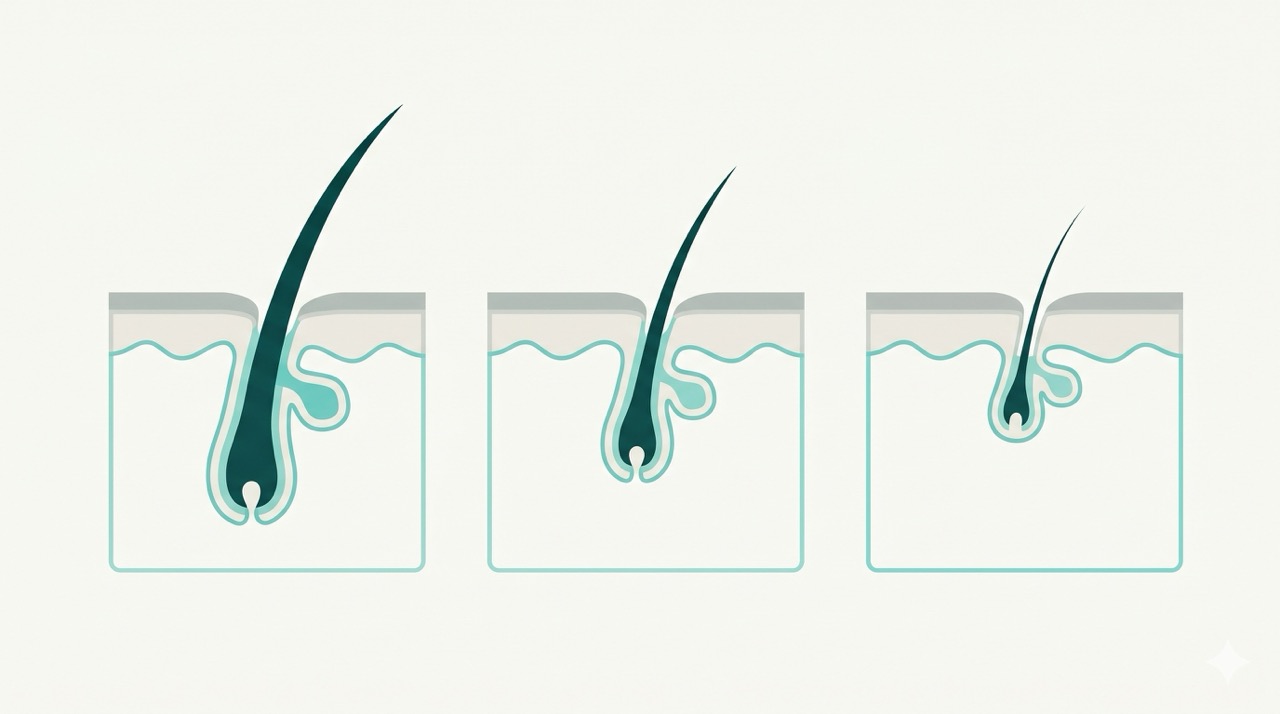
In sensitive follicles, DHT binds on and gradually shortens that growth phase. With each cycle the follicle shrinks a little more — a process called miniaturisation. The hairs it produces get progressively finer, shorter and lighter, until eventually they’re barely there at all. It’s not that your hair “falls out” overnight; it slowly fades down to peach fuzz.
Here’s the telling part: men who are born without working type-2 5-alpha-reductase (and so make very little DHT) essentially don’t get male pattern baldness. That’s the clearest fingerprint there is that DHT is the main culprit.
Why it shows up where it does
The follicles at your temples and crown tend to be the most DHT-sensitive, which is why male pattern baldness so often starts as a receding hairline and a thinning spot on top — and why the hair around the back and sides usually hangs on. That stubborn “horseshoe” is simply where the follicles don’t care much about DHT.
Clinicians often map this with the Norwood scale, a simple set of stages from a slightly receding hairline through to more advanced loss. It’s a handy shorthand for tracking where you are and what to realistically expect.
So… can you do anything about it?
Often, yes — especially if you catch it early. There are two main levers that proven treatments pull:
- Lower the DHT. Medicines in the “5-alpha-reductase inhibitor” class (DHT blockers) reduce how much DHT your body makes, taking the pressure off sensitive follicles.
- Boost the blood flow. Topical treatments applied to the scalp can improve blood supply to the follicle, helping hairs grow for longer and come through thicker.
Some people use one; some use both, as they work in different, complementary ways. The right approach for you — and whether treatment is suitable at all — is a clinical decision, so we’ve kept the specifics (which option, what strength, how) for your consultation rather than guessing from a blog.
⚠️ Set your expectations honestly: treatment is about holding the line and sometimes regaining ground — not flipping a switch back to age 18. Results take months, not days, and they generally depend on keeping the treatment going. Stop, and the DHT effect simply picks up where it left off.
⚠️ A note for households: DHT-blocking tablets are not for women, and women who are or could become pregnant should not handle crushed or broken tablets, because of the risk to a developing baby. If that applies to anyone at home, keep the medicine sealed and stored safely.
A frank word on side effects
Most men tolerate these treatments well — but they’re real medicines, and you deserve the full picture before you start. DHT-blocking medicines carry a recognised risk of sexual side effects (such as reduced sex drive or difficulty with erections), which in a minority of cases can persist after stopping. The UK regulator (the MHRA) has also highlighted a link with low mood, depression and suicidal thoughts, and now includes a patient alert card in every pack. Topical “blood-flow” treatments more commonly cause things like scalp irritation, or an early burst of shedding as follicles reset.
None of this is meant to scare you off — it’s meant to help you make an informed choice with your clinician, who’ll ask about your history (including any history of depression) before recommending anything.
What’s normal, what to check, what’s urgent
A simple traffic-light guide if you do start treatment. Keep it somewhere handy.
🟢 Usually normal
Slow progress (real change takes a few months), a bit of scalp dryness or irritation from topical treatment, and a short spell of increased shedding when you first start a blood-flow treatment — this is the old hairs making way for new ones, and it usually settles.
🟠 Check in with your clinician
Any change in your sex drive or erections, persistent scalp irritation, unwanted hair growth elsewhere, shedding that keeps going well past the early weeks, or no change at all after several months. Don’t tough it out — message your clinical team through your portal and we’ll review your plan.
🔴 Stop and get help straight away
If you ever notice low mood, depression, or any thoughts of harming yourself while taking a DHT-blocking medicine, stop the medicine and seek help right away — contact your clinician or GP, call 111, or 999 if you’re in immediate danger. You can also talk to the Samaritans free, any time, on 116 123. The same urgency applies to signs of a serious allergic reaction — swelling of the face, lips or throat, or trouble breathing.
Caught it early? That’s good news.
The best time to act on hair loss is before it’s advanced. Start our quick online assessment and a Trimu clinician will talk you through whether treatment makes sense for your stage, your goals and your health — no awkward appointments required.
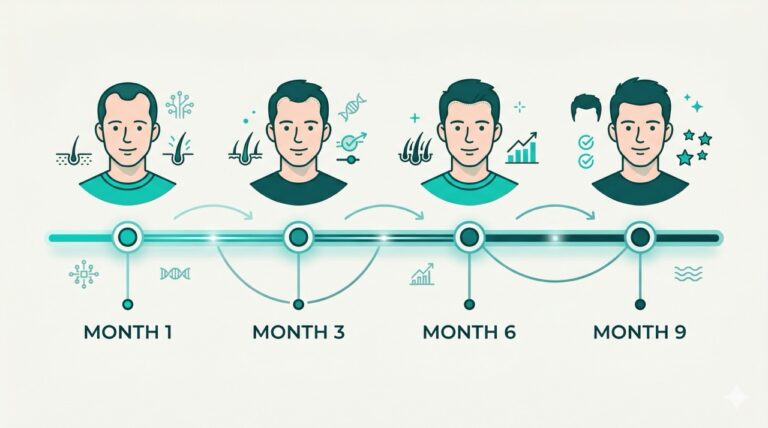
✨ Track it with “My Journey”
Hair changes are slow, which makes them hard to judge in the mirror day to day. Inside your Trimu patient portal, My Journey lets you log progress photos over time, see the trend rather than the daily noise, get gentle reminders so you stay consistent (the part that really matters), and message your clinical team whenever something comes up. It’s the easiest way to actually see whether your treatment is working.
Frequently asked questions
Does going bald mean I have too much testosterone?
No. It’s not about how much testosterone or DHT you have — it’s about how sensitive your follicles are to DHT, which is genetic. Plenty of men with average hormone levels still go bald, and vice versa.
Did stress or my diet cause this?
Pattern baldness is mainly down to genetics and DHT. Stress, illness or big dietary changes can trigger other kinds of shedding, which often recover — so if your hair loss came on suddenly or in patches, it’s worth getting it assessed rather than assuming it’s pattern baldness.
Can I actually regrow hair, or just slow the loss?
Both are possible, with realistic limits. Treatment is best at stabilising what you’ve got and can regrow some hair, especially when miniaturisation isn’t too far along. The earlier you start, the more there is to protect.
Do I have to keep taking it forever?
The benefits depend on staying on treatment. DHT doesn’t go away, so if you stop, the original process resumes and gains are gradually lost over the following months.
How long until I see a difference?
Usually a few months before changes are noticeable, and longer to judge the full effect. Hair is slow — consistency and patience do most of the heavy lifting.
Can women use the same treatment?
Not the DHT-blocking tablets — they’re not suitable for women, especially during pregnancy. Female hair loss is assessed differently, so a tailored consultation is the right starting point.
Looking for something else?
We cover more than hair loss. Explore our other treatment pathways:
Medical disclaimer. This article is for general education and isn’t a substitute for personalised medical advice. Hair-loss medicines referred to here are prescription-only and are supplied only after an online consultation with a Trimu clinician, who will confirm whether treatment is appropriate and safe for you. Always read the patient information leaflet and any patient alert card supplied with your medicine, and report any suspected side effects to your clinician or via the MHRA Yellow Card scheme (yellowcard.mhra.gov.uk). Trimu (AO Health Ltd) is registered with the Care Quality Commission (CQC). If you think you’re experiencing a medical emergency, call 999. Information last reviewed June 2026.